
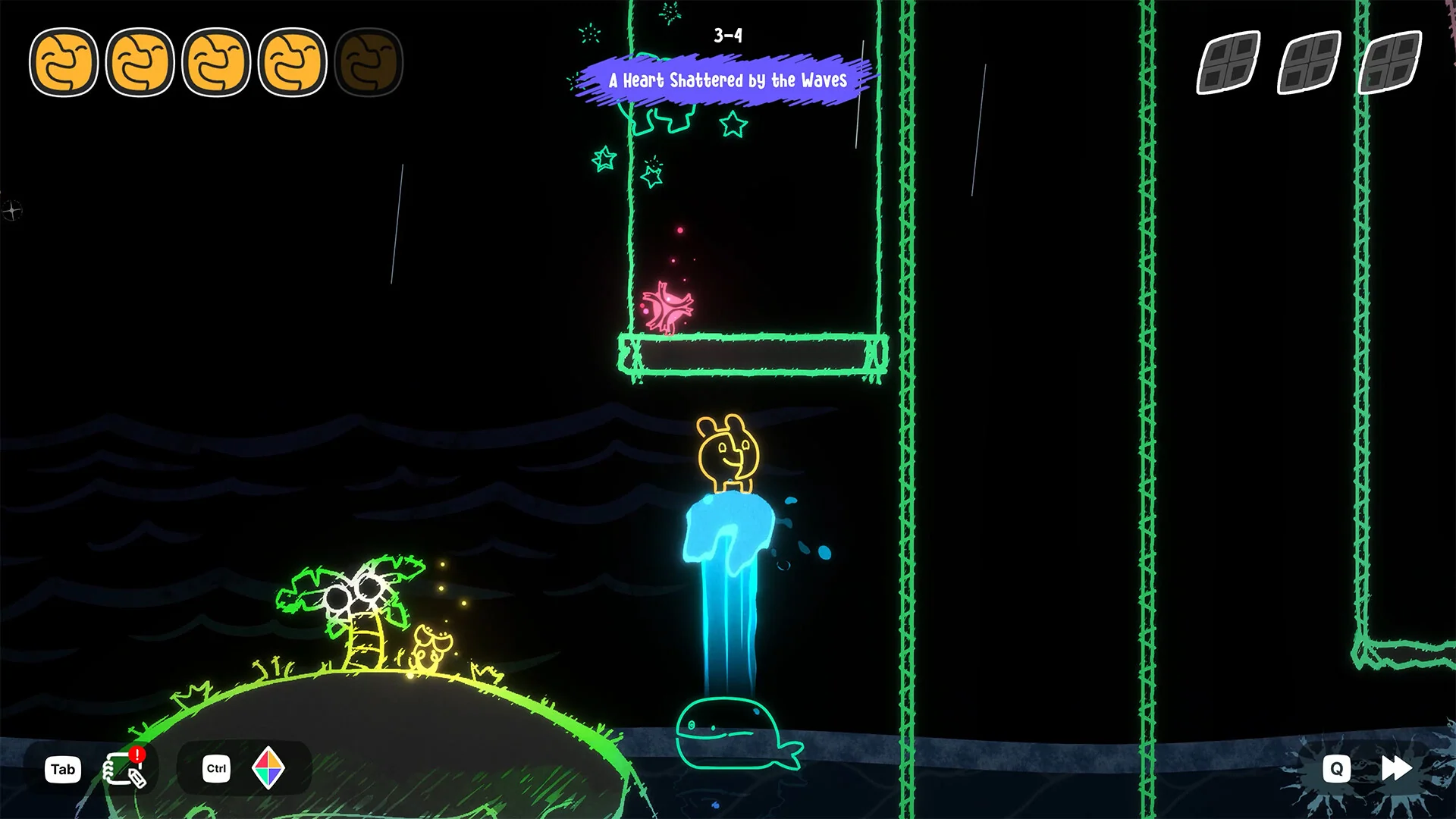
Emotion transfer is level design
Changing a spirit can alter whether it threatens Mono, creates movement, opens a lane or becomes part of a chain reaction. That means the creature itself is effectively a movable platform, switch or hazard whose function depends on emotion.
When a room supplies an emotion but applying it to Mono produces no useful geometry, stop. The game is probably asking you to edit an actor instead.
The Panic Jungle alligator is the clearest tutorial example
Current long-form footage shows an alligator-like spirit that can bite when approached in one state, while another state makes it useful for gaining height. The exact animation is less important than the lesson: behavior is state-dependent.
This is why categorizing spirits as “enemy” can make later puzzles confusing. The same creature may be a hazard on entry and a tool after you transfer an emotion.
Small spirits can be part of the chain
Creator footage also shows smaller carriers such as butterflies with emotion interactions. In rooms with multiple actors, follow the flow of the emotion: source → carrier/target → changed behavior → new route. If the final route is correct but the first transfer target is wrong, the room can look completely inert.
How to read a spirit puzzle in 20 seconds
- Find the blocked route.Do not start with the nearest creature; start with the exit.
- Identify the behavior you need.Higher bounce? safer path? forceful movement? access through a hazard?
- Match that behavior to an emotion.Use the four-emotion guide as the baseline.
- Choose the recipient.If Mono’s movement does not create the route, change the spirit.
Why there is no “complete bestiary” yet
The current evidence is excellent for World 1 mechanics but not for a shipping-build list of every spirit across all four worlds. This guide stays focused on the transferable system. A full bestiary should wait for full-game evidence rather than padding the site with names inferred from auto-captions.
Debug the target before you debug the color
When a room refuses to respond, run the problem in this order: first confirm the obstacle type, then confirm the emotion, then confirm the recipient. Players often jump directly from “this color did not work” to “I need a different color,” but MONOWAVE’s system makes the recipient equally important. The same Happiness state can be useless on Mono and perfect on a nearby creature.
If a spirit visibly changes expression or motion after a transfer, treat that reaction as feedback. The game is telling you the state was accepted even if the route is not obvious yet. Look for a changed bounce, patrol, posture or interaction range before undoing it.
What not to assume from current World 1 footage
Do not assume every later spirit has the same four behaviors, or that an alligator pattern will repeat one-for-one in another world. The official full-game description supports the broad behavior-changing system, not a universal lookup table. Later guides should document each new spirit only after the shipping build shows what its states actually do.
The official story frame explains why spirits change state
The official listing gives the reason the inhabitants behave the way they do: the four Emotions used to be nurtured by the Prism Tree at the center of the world, and when the Emotion Shards inside it vanished, the emotions scattered across the land and the tree began to wither. Mono is a newborn guardian spirit sent to reunite them. That framing is worth keeping in your head while playing, because it explains why a spirit is not a fixed enemy or helper — it is a creature whose behavior depends on which emotion reached it and in what order.
The same listing states plainly that Mono's powers resonate with the inhabitants and change their behavior, and it frames the wider cast as characters rather than a hazard list. For guide use that means: when a room includes several actors, treat every one of them as a possible transfer target before you decide the room is unsolvable. Official anxiety wording ("evade potential threats and navigate difficult terrain with heightened senses") also matches how this guide uses that emotion — as a reading tool for hazards, not a damage ability. Source: official Steam listing, checked 2026-09-16.